
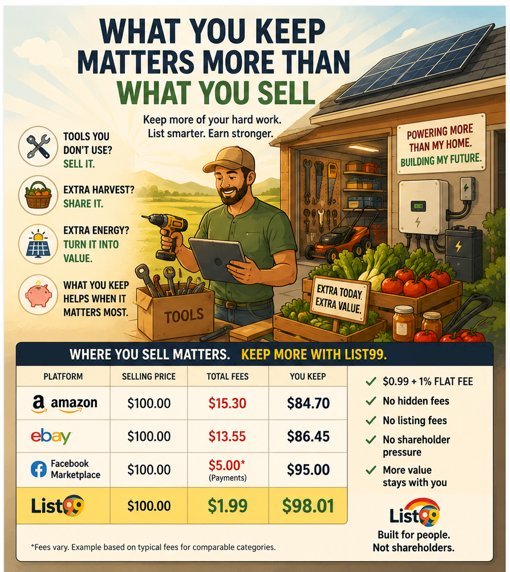
Economic uncertainty has a way of pushing people back toward the resources they already have — the garage full of tools that don't get used anymore, the extra harvest that's more than one household needs, the solar setup that's producing more than the home consumes. Liquidating what you already have, or selling what you can produce, is one of the oldest and most direct ways to create financial breathing room.
But here's the quiet catch: how much of that value you actually keep depends enormously on where you sell it.
Most of the big platforms people default to are publicly traded companies, and that comes with a structural pressure that has nothing to do with you or your product: a public company's stock price is judged, quarter after quarter, largely on whether earnings keep growing — reflected in something investors watch closely called the P/E ratio, the price of a share relative to how much profit the company makes per share. Meeting that expectation, year after year, tends to mean margins have to expand somewhere. Fees are one of the easiest levers to pull, because they're spread across millions of individual sellers who each absorb a little more, quietly, one transaction at a time.
That's not a conspiracy — it's just how public markets work. But it means the platform's incentive and your incentive as a seller are not actually aligned. The platform needs to keep extracting more. You need to keep more of what you sell.
List99 is built differently on purpose. We're privately held, debt-free, and have no outside investors demanding quarterly growth in fees. That's not a marketing slogan — it's a structural choice that removes the exact pressure that pushes other platforms' fees upward over time. Whether you're selling surplus produce, tools you no longer need, or resources tied to a renewable setup that's finally paying for itself, what you keep is what actually helps in a moment of real economic uncertainty — not what a shareholder-driven fee schedule leaves behind.
See exactly what you'd keep on your own item: Try the Fee Comparison Calculator →