
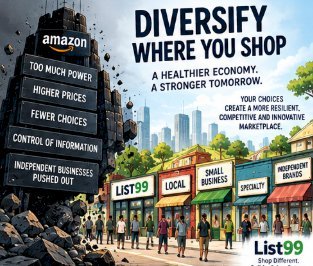
Why We Have an Obligation to Diversify Where We Shop
Most investors understand one of the simplest principles of financial risk:
Do not put everything in one place.
Diversification protects us because concentration creates vulnerability.
If one investment fails, the others remain.
If one company struggles, your entire future does not depend upon it.
If one sector changes, alternatives still exist.
We understand this principle when managing money.
We should begin understanding it when spending money too.
Because when millions of consumers concentrate their purchasing on a single marketplace, we are doing something remarkably similar to putting all of our economic eggs in one basket.
Except the thing being concentrated is not merely money.
It is power.
Convenience Can Quietly Become Dependence
There are good reasons consumers gravitate toward large marketplaces.
Selection matters.
Fast delivery matters.
Trust matters.
Easy returns matter.
Having one account and one checkout matters.
Convenience is real economic value.
Amazon, in particular, demonstrated just how valuable an extraordinarily convenient marketplace could become.
But there is a difference between appreciating convenience and allowing convenience to eliminate meaningful alternatives.
A platform does not need to force anyone to use it in order to acquire enormous power.
Millions of people can voluntarily make the same individually rational choice until their collective decisions produce an outcome few of them consciously intended:
dependence on one marketplace.
That is one of the paradoxes of markets.
A decision can make perfect sense for one consumer today while millions of identical decisions gradually make tomorrow's marketplace worse for everyone.
Every Purchase Strengthens Something
When you buy a product, you are doing more than obtaining that product.
Your money becomes revenue.
Revenue supports infrastructure.
Revenue finances expansion.
Revenue attracts investment.
Revenue improves logistics.
Revenue funds advertising.
Revenue trains algorithms.
Revenue allows companies to negotiate better terms.
Revenue helps determine which businesses survive long enough to compete tomorrow.
In other words:
Every purchase strengthens something.
This does not mean consumers should feel guilty about ordinary shopping.
It means we should understand what repeated purchasing behavior accomplishes collectively.
If nearly all of our spending continuously flows through the same marketplace, we are helping that marketplace become increasingly difficult for anyone else to challenge.
Eventually, we may discover that the alternatives we assumed would always exist disappeared while we were enjoying the convenience.
Competition Cannot Survive Without Customers
People often say they want competition.
They want independent businesses.
They want small sellers.
They want local stores.
They want alternatives to dominant technology companies.
But competitors cannot survive on public approval.
They need transactions.
A marketplace cannot compete because people say:
"I'm glad somebody is challenging Amazon."
It competes when people actually purchase something there.
A local retailer cannot survive because a community says:
"We really should support local businesses."
It survives when people occasionally walk through the door and spend money.
An independent seller cannot remain independent on goodwill.
Commerce requires commerce.
That creates a modest but meaningful responsibility for consumers.
If we genuinely value competition, occasionally using competitors is part of maintaining it.
This Is Not About Boycotting Amazon
The argument for diversified shopping should not become another purity test.
You do not need to delete your Amazon account.
You do not need to feel guilty when Amazon has the best price.
You do not need to wait a week for something you urgently need simply to make an ideological point.
And you certainly should not spend significantly more money than you can afford merely to demonstrate economic virtue.
That would defeat the purpose.
The argument is much simpler:
When reasonable alternatives exist, use some of them.
If another marketplace offers the same item at a comparable price, consider buying it there.
If a local seller has what you need, occasionally buy locally.
If an independent business provides good value, give it a transaction.
If a new marketplace offers fairer economics without asking you to sacrifice price, safety or convenience, give it an opportunity to compete.
That is not anti-Amazon.
It is pro-competition.
And ultimately, competition is pro-consumer.
Why Dominance Creates Leverage
Imagine a marketplace controls only a tiny fraction of online shopping.
If it dramatically raises seller fees, sellers can leave.
If it treats customers poorly, customers can shop elsewhere.
If it manipulates discovery, competing marketplaces can advertise themselves as more transparent.
The marketplace must continuously earn participation.
Now imagine that the same marketplace becomes the default starting point for an enormous share of consumers.
Everything changes.
Sellers may feel they cannot afford to leave because that is where the customers are.
Brands may feel they cannot afford to leave because competitors will take their place.
Smaller marketplaces struggle to attract sellers because they lack customers.
Customers hesitate to use smaller marketplaces because they lack sellers.
This creates a feedback loop:
Customers attract sellers.
Sellers attract customers.
Both increase the platform's power.
At some point, scale stops being merely an operational advantage.
It becomes leverage.
Monopoly Power Does Not Arrive With a Warning Label
Market concentration rarely announces itself.
There is no notification on your phone saying:
Congratulations. Your latest purchase has reduced competitive pressure by 0.00000001%.
Nothing dramatic happens when one person moves another purchase to a dominant platform.
Nothing dramatic happens when the next person does it.
Or the next million.
That is precisely why concentration is difficult to perceive.
The consequences emerge gradually.
A competitor closes.
An independent seller disappears.
A local store stops carrying something.
A marketplace increases a fee.
More search results become sponsored.
A service that was once inexpensive becomes more expensive.
Terms become less negotiable.
Consumers adapt because each individual change seems tolerable.
Then one day the marketplace looks fundamentally different from the competitive environment that created it.
Sellers Need More Than One Door to the Consumer
Marketplace diversity matters enormously to sellers.
Imagine building a business where 80 percent of your customers come through one platform.
You technically own a business.
But one change to an algorithm can affect your revenue.
One fee increase can affect your margins.
One account suspension can threaten your survival.
One policy change can make your existing business model uneconomical.
That is an extraordinary amount of external control over supposedly independent enterprise.
Now imagine the same seller receives customers from five meaningful marketplaces, their own website, local customers and other channels.
The seller has leverage again.
If one marketplace behaves unreasonably, the seller can reduce participation there.
That ability to leave disciplines platforms.
Alternatives give sellers agency.
And seller agency eventually benefits consumers.
Consumers Need More Than One Door to Sellers
The same principle works in reverse.
Consumers benefit when businesses compete for them.
Different marketplaces can compete on:
Price.
Fees.
Shipping.
Returns.
Discovery.
Customer service.
Privacy.
Seller treatment.
Product quality.
Local participation.
Community features.
Innovation.
The existence of alternatives creates pressure to improve.
Without alternatives, consumers increasingly receive whatever the dominant provider decides is sufficient.
That is why competition is not merely about giving entrepreneurs opportunities.
Competition is a consumer protection mechanism.
Sometimes the strongest protection against a bad policy is not a regulation.
It is a competitor.
Diversification Protects Innovation
Market concentration creates another problem that receives less attention.
It can determine which ideas are economically viable.
Suppose someone invents a dramatically better way to connect buyers and sellers.
The technology may be excellent.
The economics may be fairer.
The experience may be better.
But none of that matters if consumers never give the new platform enough activity to reach sustainable scale.
Incumbents possess enormous advantages.
Existing customers.
Existing sellers.
Existing infrastructure.
Brand recognition.
Data.
Capital.
Logistics.
Network effects.
A competitor therefore does not merely need a better idea.
It needs people willing to try it.
That means consumer experimentation is part of the innovation ecosystem.
When consumers occasionally try alternatives, they create space for new models to prove themselves.
Economic Diversity Is Resilience
We learned something important about concentrated supply chains when global disruptions exposed how dependent entire industries had become upon a limited number of suppliers and production centers.
Efficiency matters.
But redundancy matters too.
An economy with multiple marketplaces, multiple retailers, multiple distribution systems and multiple ways for buyers and sellers to find each other is more resilient than one dependent upon a single gatekeeper.
If one system fails, others remain.
If one company makes poor decisions, the entire economy does not inherit them.
If one platform changes its policies, commerce has somewhere else to go.
Diversity creates redundancy.
Redundancy creates resilience.
That principle applies to digital marketplaces just as surely as it applies to physical supply chains.
Your Convenience Today Can Shape Your Choices Tomorrow
This is where the consumer's role becomes important.
Markets are not abstract forces floating above society.
Markets are aggregated human decisions.
Companies become dominant because people use them.
Competitors survive because people use them.
Business models spread because people finance them through purchases.
Every consumer has very little power individually.
But consumers collectively possess extraordinary power.
The irony is that we often surrender that power because each individual decision seems too small to matter.
One purchase does not matter much.
Neither does one vote.
Neither does one drop of water.
Scale changes the meaning of small things.
Economic Activism Can Be Extremely Ordinary
Economic activism does not always require a protest sign.
Sometimes it looks like buying dog food from one marketplace this month and another marketplace next month.
Buying something from a neighborhood business.
Trying a new online marketplace.
Hiring a local service provider.
Buying directly from an independent seller.
Choosing a competitor when the price and value are comparable.
None of those actions will transform the economy individually.
But they preserve something important:
optionality.
They keep alternative economic pathways alive.
And optionality is one of the foundations of freedom in a market economy.
List99 Should Have to Earn Your Business Too
This principle applies to List99.
We do not believe consumers owe List99 their purchases simply because we criticize excessive marketplace concentration.
List99 should have to compete.
If another marketplace provides dramatically better value, consumers should be free to use it.
If we charge unreasonable fees, another company should be able to challenge us.
If we stop innovating, someone should build something better.
If we ever acquire significant scale, consumers should continue maintaining alternatives.
That is not a weakness in the philosophy.
It is the philosophy.
No marketplace should become so indispensable that users lose meaningful leverage over it — including ours.
Competition should remain permanent.
What List99 Is Trying to Offer
List99 exists partly because we believe marketplace technology can be built around a different objective.
Not:
How much economic activity can we control?
But:
How cheaply and fairly can we help economic activity occur?
That means creating opportunities for sellers.
Reducing unnecessary transaction costs.
Connecting local communities.
Making goods discoverable.
Helping services reach customers.
Using technology to lower the friction involved in participating in commerce.
But List99 alone cannot create marketplace diversity.
Neither can any other competitor.
Consumers ultimately determine whether alternatives survive.
Spend Like Your Choices Matter
You do not have to transform your shopping habits overnight.
You do not have to abandon convenience.
You do not have to research every corporation before purchasing toothpaste.
Start with something much simpler.
Every once in a while, when you are about to press Buy, ask:
Could I reasonably buy this somewhere else?
If the answer is yes, occasionally do it.
Not because the dominant marketplace is necessarily evil.
Not because every competitor is automatically good.
Not because buying elsewhere makes someone morally superior.
Do it because concentrated economic power creates risk.
Do it because competition requires participants.
Do it because independent businesses need customers.
Do it because innovation needs an opportunity to emerge.
Do it because the ability to choose tomorrow depends partly upon the choices we make today.
We diversify our investments because we understand that putting everything in one place gives one failure too much power over our future.
Perhaps we should begin applying the same wisdom to commerce.
Diversify where you shop.
Not as charity.
Not as punishment.
As maintenance.
Because a competitive marketplace is something consumers inherit only if consumers help keep it competitive.
Slug: why-we-have-an-obligation-to-diversify-where-we-shop
Summary: We diversify investments because concentrated power creates risk. Commerce deserves the same thinking. When consumers spread some of their spending among competing marketplaces, independent sellers and local businesses, they help preserve competition, innovation and their own future economic choices.
Tags: Consumer Power, Marketplace Diversity, Competition, Independent Business, Economic Resilience, List99
Meta keywords: diversify shopping, Amazon alternatives, marketplace competition, consumer power, independent sellers, monopoly power, economic resilience, fair commerce, List99