
Every dollar a business spends supports something.
Sometimes the connection is obvious.
Buy inventory from a supplier and you support that supplier.
Hire someone and you support a job.
Purchase from a neighborhood business and some of that money remains within the surrounding economy.
But in the digital economy, the connections can be harder to see.
The marketplace you use, software you subscribe to, advertisements you purchase and services you depend upon are not simply tools.
They are organizations.
And your participation helps those organizations grow.
That makes a surprisingly important question worth asking:
Does the infrastructure supporting your business support the kind of economy you actually want to exist?
Convenience Has a Cost Beyond Money
Most entrepreneurs understandably choose platforms for practical reasons.
Where are the customers?
How much will it cost?
How easy is it to use?
Will my products sell?
Those questions matter.
But another question is becoming increasingly important:
What am I helping build by using it?
When millions of independent businesses become dependent on a handful of enormous platforms, economic power naturally becomes concentrated.
Those platforms can influence which products people discover, which businesses receive visibility, how sellers communicate with customers, what information is collected and how much participation ultimately costs.
None of this requires imagining some secret conspiracy.
It is simply the predictable consequence of concentrated economic power.
Companies pursue their incentives.
Platforms pursue growth.
Shareholders expect returns.
The question for independent sellers is whether those incentives remain aligned with theirs.
Independence Is an Economic Asset
Entrepreneurs understand diversification.
You wouldn't normally want one customer responsible for 100% of your revenue.
You wouldn't want one supplier to be the only company capable of keeping your business alive.
Platform dependence deserves the same consideration.
The more ways entrepreneurs have to reach customers, the more resilient independent commerce becomes.
That is why alternatives matter.
Even if you already sell elsewhere, establishing another storefront or marketplace presence can mean another source of discovery, another community and another path between you and your customers.
Competition among marketplaces is good for sellers for exactly the same reason competition among sellers is good for buyers.
Choice creates accountability.
Technology Should Serve People
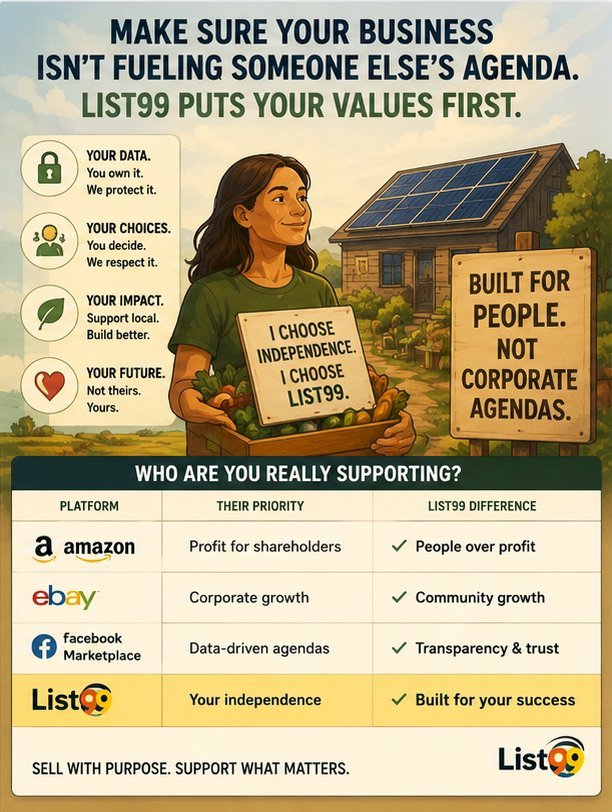
List99 is being built around a different philosophy of marketplace growth.
We want technology to help people participate in commerce — not make participation increasingly dependent upon the technology company itself.
That means creating opportunities for conventional sellers while also making room for local makers, farmers, collectors, small businesses, independent entrepreneurs, community events and people simply trying to turn something useful into income.
It means asking whether technology can distribute opportunity rather than continually concentrating it.
And it means recognizing something corporations sometimes forget:
the economy ultimately exists to serve human beings. Human beings do not exist to serve the economy.
You Don't Have to Agree With Everyone to Support a Better Marketplace
A people-first marketplace doesn't require everyone using it to share the same politics, philosophy or worldview.
Quite the opposite.
Economic independence means people should have more choices.
A farmer and a software developer may have almost nothing in common.
A collector and a craftsperson may see the world completely differently.
A small retailer and someone clearing tools out of their garage may have entirely different reasons for selling.
That's fine.
They don't need ideological agreement.
They need a fair place to exchange value.
The principle connecting them is much simpler:
If you create value, you should have a meaningful opportunity to benefit from it.
Build the Economy You Want to Live In
No marketplace will change the economy by itself.
But millions of individual decisions eventually do.
Where we buy matters.
Where we sell matters.
What businesses we support matters.
What technologies we allow ourselves to become dependent upon matters.
And where alternatives don't exist, sometimes someone has to build one.
That's what List99 is attempting to do.
Not by telling people what they must believe.
Not by demanding loyalty.
And not by pretending commerce can exist without profit.
But by offering another choice.
A marketplace where commerce can remain commerce, community can remain human, and entrepreneurs can keep more control over the value they create.
Your work builds something.
Your money supports something.
Your business strengthens something.
Make sure it's something you actually want to help build.
List99 — Built for people, not corporate agendas.