Every sale begins with someone creating value.
Maybe you found something another person needs. Maybe you grew it, repaired it, designed it, built it, imported it, collected it, or simply took the time to photograph it, describe it, list it, package it and get it into someone else's hands.
Whatever the case, you created the reason the transaction exists.
Yet somewhere along the way, online commerce developed a strange assumption: the platform facilitating that transaction should be entitled to an ever-growing share of its value.
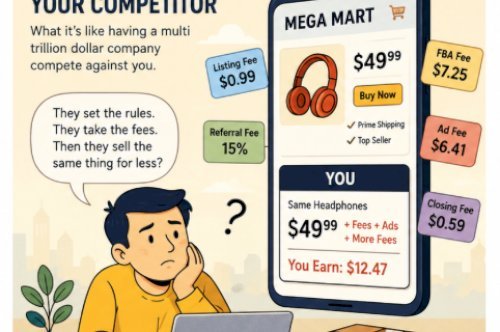
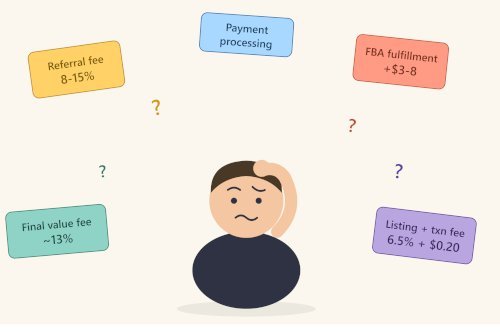
There can be selling fees. Payment fees. Advertising costs. Promoted placement. Subscription charges. Fulfillment expenses. And sometimes sellers discover that simply reaching the customers they once reached organically now requires paying again.
Individually, each charge can sound reasonable.
Collectively, they can change the economics of a small business.
The Difference Between Creating Value and Extracting It
A marketplace obviously costs money to operate. Servers cost money. Payment processing costs money. Fraud prevention, customer service, development and security all cost money.
A sustainable marketplace therefore needs revenue.
But there is an important distinction between earning money by providing a useful service and designing an ecosystem to extract the maximum possible amount from every transaction occurring inside it.
Those are two very different philosophies.
When the objective becomes maximizing extraction, the seller can slowly stop feeling like the customer of the platform and start becoming the resource being monetized.
Your products attract shoppers.
Your work creates inventory.
Your reputation creates trust.
Your advertising brings attention.
Your transactions generate data.
Your success generates fees.
And eventually you may find yourself paying increasingly large amounts simply to continue reaching the audience your own work helped create.
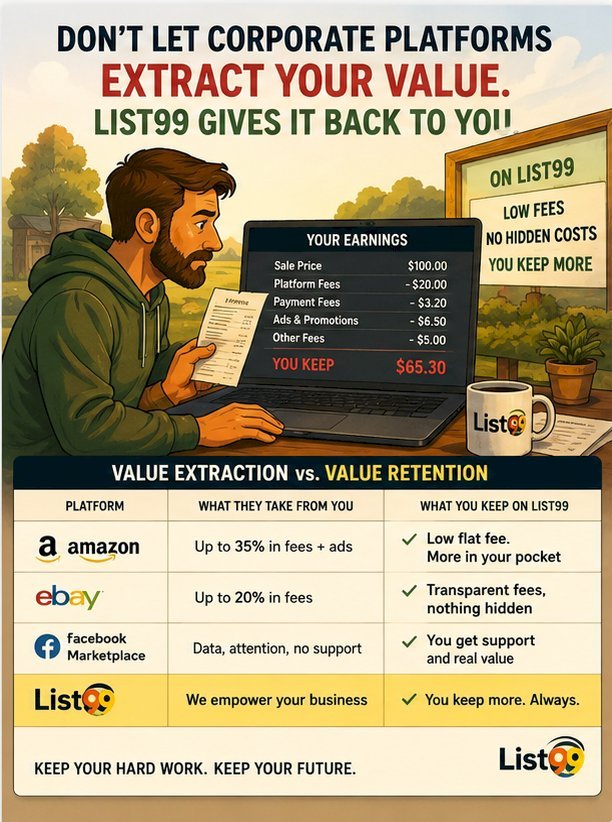
List99 Starts From a Different Question
Instead of asking:
"How much value can the marketplace capture from this transaction?"
List99 starts with:
"How much value can we leave with the people who actually created it?"
That difference matters.
List99 is being built around a simple idea: the marketplace should provide infrastructure for commerce without trying to become the primary beneficiary of commerce.
The seller should be able to grow.
The buyer should receive value.
The platform should earn enough to sustainably provide the service connecting them.
Those three things can coexist.
Commerce does not have to be a zero-sum contest between a platform and the people using it.
Small Percentages Become Big Numbers
A few dollars may not seem significant on a single transaction.
But entrepreneurs don't build businesses around one transaction.
They build them around hundreds, thousands and eventually tens of thousands of transactions.
Money retained by a business can become inventory.
It can become equipment.
It can become advertising.
It can become an employee's paycheck.
It can become lower prices for customers.
It can become savings that allow a family business to survive a difficult month.
And sometimes it simply becomes the reward someone deserves for taking the risk of building something in the first place.
That is why what you keep matters just as much as what you sell.
Build Something That Belongs to You
The internet created an extraordinary opportunity for ordinary people to reach customers around the world.
The next evolution of internet commerce should not be finding increasingly sophisticated ways to extract value from those people.
It should be giving them better tools to create it.
List99 wants to be part of that alternative.
Sell something.
Build something.
Grow something.
Repair something.
Create something.
Turn what you know, own or produce into opportunity.
And when you create that value, keep as much of it as possible.
Because your business should be building your future — not merely feeding someone else's machine.
List99 — Built for people, not shareholders.